Wednesday, November 16

Unveiling of New Temporary Art Bring Tears to their Eyes


Tuesday, November 15th, under a cloudy sky and the glacial UN building, Jonathan, of the New York City's Art in the Parks Program stood in front of a crowd of almost 30 people to unveil a new temporary work of art by Rachel Owens entitled, Inveterate Composition for Clare. The event took place in Dag Hammarskjold Plaza at 1st Avenue and 47th Street. The atmosphere was a bittersweet one, for the 'Clare' referred to in the sculpture's name is the late Clare Weiss, who worked as the curator of temporary art for the Art in the Parks Program until her death in 2010 after struggling with breast cancer.
The fruition of this piece marks one of the last Ms. Weiss curated.
"The last thing I did with Clare was pretty much interview Rachel and-I don't believe in karma- but I think it was good." Jonathan said through tears as he ended his opening speech.
Inveterate Composition for Clare will stand in the center of the park until May 2012. It is a statue built from one Hummer SUV. The pieces have been remodeled and painted white to take the shape of an iceberg. Within, Ms. Owens placed the first underwater recording of a humpback whale made in 1971. The sound echoes from the great structure belly like from the belly of a hungry beast. The piece is in response to issues on global warming and consumerism to which Ms. Owens insisted,
"Though this piece does not propagandize, it sits in solidarity with freedom of speech and battles against oppression."
Although Inveterate was created originally for the location, Owens hopes that it will move on to other places at the end of its term.
Ms. Owens, born in Atlanta, Georgia is currently living and working in Brooklyn. With the exception of an exhibit in Miami, Owens has shown only locally to New York City. Many of her sculptures comment on global warming and the environment. She often uses found materials to create situations surrounding animals and their relationship to waste and consumerism.
As this is one of Ms. Weiss' last acheivments as curator, the Parks Department, like the scultpture has chosen not to forget her. A new award, entitled The Clare Weiss Emerging Artist Award will be put into action next year, the deadline being January 2012. The award recognizes upcoming artists as well as locations around the city, underserved with public art, the current outstanding location for the project is Joyce Kilmer Park in the Bronx.

Smooth Is The Water Where The Brook Runs Deep.


(A worker in a New York Water Plant. Photo credit: Randolph Mase)
                   The New York City Water Board is rarely spoken of, but perhaps that is because the nature of its service: To remain as seemingly smooth and natural as spring water rounding a river rock; a set of only six board members (appointed to two-year terms by the mayor) working behind the scenes of something so omnipresent.
An afterthought for many New Yorkers, the water infrastructure brings in an estimated one billion gallons of water to New York City each day. It is the responsibility of the New York City Water Board to determine the rates and regulations that fund this flow of water throughout NYC. The Water and Sewer System is simply referred to as ‘The System”, but the Board is invested in considerable transparency, offering regularly updated, accessible reports on meeting minutes, rate regulations, public notices, and more, including a little Blue Book with very large plans.
In addition to determining rates, the New York City Water Board (working with the Department of Environmental Protection) is involved in initiatives to fund large projects. The largest and most expansive are the plans for the Croton Water Filtration Plant.
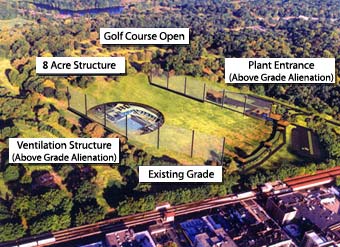
Plans for the Croton Water Filtration Plant. Photo Credit: NYC Gov Parks)

The Croton Water Filtration Plant, which will start in 2012 and is planned to be operational in 2013, will be the first WTP to be located in the boroughs of New York.  It will have the capacity to handle 30% of New York’s water supply, and will be located underneath the Bronx’s Van Cortlandt Park. All told, it will be the single largest construction contract in New York history.
At an estimated cost of 3 billion dollars and 12 acre construction (including an estimated 73,000m of rock and soil to be excavated), the DEP has worked to ensure good will with the Bronx community. The DEP has agreed, in partnership with the New York City Department of Parks and Recreation, to offer $200 million toward developing parks throughout the Bronx. Space has been an issue, including the Plant’s temporary takeover of the Mosholu Golf Course in Van Cortlandt Park. Ten acres of land will be turned back into a gold course upon completion of the Plant.
While issues of space in the Plant have arisen, funding has proven an occasionally even choppier obstacle.  Funding for the Croton Water Filtration Plant (and other projects) has been costly. According to a 2012 Blue Book report, DEP’s ‘current daily expenditure rate is nearly $9 million per day on construction, design, and construction management’. One way of closing the current $26.6 Billion debt is a proposal by the board to increase water and sewer rates by 7.5%. The estimated annual household cost to fund the Croton Water Filtration Plant mandate would be $44, nearly double the cost of the Ultraviolet Disinfection Facility ($23), but only slightly more than the Newton Creek Treatment Plant ($42).
If New Yorkers feel the rates are too high, too low, or, even, just right, the New York City Water Board will be meeting this Friday (November 18th) at 8:30 A.M at 22 Reade Street (Spector Hall). 

A Cellphone Can Be More Powerful Than a Press Badge

It is not news that twitter and other forms of social media have become an invaluable resource for reporters and revolutionaries alike, and the events at Zuccotti Park in the wee hours of November 15 sent the twitter accounts of activists and journalists into a caps-locked frenzy.
A twitter user uploaded video of mace being used against protesters to Y-Frog, a service that allows twitter users to share pictures and videos. You can watch the video here.

At around 1 am on November 15th I opened my Tumblr dashboard, a blogging platform heralded for its simplicity, and saw a post by Suzy Exposito (aka Suzy X), a former Eugene Lang student, simply stating “1:17 AM: Zuccotti park is being raided by nypd right now” with a link to the Occupy Wall Street livestream. From the comfort of my Brooklyn apartment I was able to watch as the NYPD threw personal property, the contents of the Occupy Wall Street public library, and tents into the garbage. And I was able to read in live time the tweets of protesters and journalists who where there.

It appeared that the Internet was filling in for journalists who were barred entrance into the park by the NYPD, and citizens were able to learn about banishment of reporters as it happened. Chris Glorioso, a reporter for NBC4, had his press badge taken away by an NYPD inspector and Twitter users fell into action. Newyorkist, the twitter account for NYCtheblog.com, tweeted a picture of the inspector and constantly informed followers on the status of journalists attempting to cover the police raid.

One journalist, who may have been the only person with a press badge to make it inside of Zuccotti Park during the raid, had an onslaught of twitter followers as he documented the experience. Josh Harkinson wrote about his experience for Mother Jones, an online publication, "The police had created a one-block buffer zone around the park—in some areas two or three blocks—and were refusing to admit even the most credentialed members of the press. A New York Times reporter had already been arrested, a member of the National Lawyers Guild told me."

After the tents were cleared, the zip-ties secured, and the NYPD's Counter Terrorism unit was sent home twitter calmed down but reports of the sheer brutality of the raid continued. Denying access to the press was blatant censorship, but has given Twitter and "citizen journalists" new power as the watchdogs of authority.
Although twitter is still rampant with absurd rumors

Keeping New York a Culture Capital

"Splotch 15" a Sol Lewitt structure on view at City Hall Park sponsored by Public Art Fund which is supported by the DCA. Photo: Jason Wyche
A tourist in New York might visit a few museums, such as the Museum of Natural History or the Met; wander around one of the three botanical gardens, in the Bronx, Brooklyn or Queens; and take in a showing of the New York City Ballet or New York City Opera. All of these institutions and many more well known, highly frequented establishments are city-owned and city-funded.
The New York City Department of Cultural Affairs (DCA) supports the 33 members of the Cultural Institutions Group (CIG). All of the mentioned institutions are part of this group. The support the DCA offers the CIG includes the city-owned property these institutions are located on and the capital needed for basic security, maintenance, administration and energy costs. It has two other funding units: Program Services, which supports 881 nonprofit cultural organizations, and Capital Projects, which provides funds for design, construction and equipment. The Department of Cultural Affairs also gives grants for small capital projects initiated in lower income neighborhoods or that target lower income audiences.
Faced with a small DCA budget when sworn into office in February 2002, current Commissioner of the Department of Cultural Affairs Kate D. Levin said, “It will be my nonstop effort to see that the cultural community is made whole to the extent that it’s possible.” In Levin’s 9 years as Commissioner, the Department consolidated two separate funding streams into the Cultural Development Fund, supported the Museum of Jewish Heritage’s new 82,000 square-foot wing, launched a new program called The Blueprints for Teaching and Learning in the Arts aiding art education in public schools, and received the then largest budget in the agency’s history in 2006.
According to a report by the Center for an Urban Future made in 2005, “New York City’s budget for arts and culture nonprofits and individual artists is unrivaled in the country.” In fiscal year 2006, the DCA had an expense budget of $131 million (larger than the National Endowment for the Arts’ annual budget) and an $803 million capital budget for 2007-2011. This June 2011, Mayor Bloomberg initially proposed cuts of $50 million to the Department of Cultural Affairs budget, continuing the trend of the Departments slowly declining share of the city budget. He later restored $30 million to their budget, bringing it to the final $149.5 million.
Out of this budget, the 33 members of the Cultural Institutions group receive $110.2. The remaining 26.3% of the budget is split between the Department’s other two funding divisions, the grants it awards to applicants and the two programs it runs, Materials for the Arts, which provides materials to organizations, and Percent for Art, which supports the creation of public art in New York City.
The Department of Cultural Affairs, in existence in some form since 1869, has a large role in the city’s cultural atmosphere. It serves as a conductor of finances to city-owned and non city-owned institutions and nonprofit cultural organizations across the five boroughs. The amount of funding it receives impacts the support it can give to large establishments and the many small arts organizations throughout New York. The preliminary fiscal year 2012 budget for the DCA is $49 million less than the 2011 budget, coming out to $101.3 million.
In July when Mayor Bloomberg restored $30 million to the 2011 DCA budget, Randall Bourscheidt, president of Alliance for the Arts, said to The Arts Newspaper, “I think that the restoration of the cultural budget is nothing short of heroic and it represents a very strong commitment from the city council and the mayor to the arts in New York.”

Monday, November 14

Impy-Wagner

Vincent R. Impellitteri being sworn in
Impy looking bored

Impy at a LIRR meeting with Governor Dewey
Impy at the dedication for the Baruch Houses (with Dewey and Eisenhower)

Robert F. Wagner campaign poster
Jr. and Sr. working on the campaign
Robert F. Wagner Sr. and Al Smith hanging out
Warren Moscow's oral history

"Leading Out the Regiment" Chapter 33 in pictures

"In 1949, Title I of a new Federal Housing Act codified a new concept---urban renewal---that insured  that Washington's role  would henceforth be as crucial as City Hall's not only on low-income housing but in most major urban reshapings." (704)
 Plans for Moses's Cross-Manhattan Expressway that would've connected the East side to the West Side of Manhattan, 12 lanes of traffic that would've gone through 31st street

Demolition on Grand St. (LES) as part of Moses's slum clearance  circa 1948.

Tammany backed mayor William O'Dwyer 1946-1950
“Sachems of Tammany Hall, 1929, including Mayor James J. Walker”
*The Political Machine that is Tammany comes back into power in the absence of La Gurdia 

*O'Dwyer gives Moses the title of  "City Construction Coordinator"
and a position as head of the Slum Clearance Committee
*As the city Construction Coordinator Moses positioned himself as the representative for the city's positions of design and construction controlling all interactions between city, state and federal funding agencies.

*He controlled the Housing authority for a decade and had complete control over the highway system
All his positions together meant he controlled funding from the Triborough Bridge Project, The State Department of Public Works and Federal Funds for Slum Clearance

"Every large scale Public work it sometimes seemed, had to have its arrangements, its payoffs, its deals and its coincidences" (714)
Carroll speculates that write offs , pay offs and favors could be covered up by the Triborough Bridge & Tunnel Authority's vast revenue in the form of : service fees, broker fees, legal fees and commissions. 
               
"He and he alone--not the city's people not, not the government officials the people elected to represent them, not the power brokers who dominated some of these officials ---decided what public works would be built, when they would be built and to what design they would be built. He was the supreme power broker" (754).

Sunday, November 13

Moses and the Mayors

Mayor William O'Dwyer

Lower Manhattan expressway- unbuilt

Mid-Manhattan Expressway- Unbuilt
Artistic rendition of the Mid-Manhattan Expressway
Photo by Triborough Bridge and Tunnel Authority
Idlewild Airport (A.K.A JFK) where the runways were terrible
Photo by T.W.A
UN Headquarters in Lower Manhattan
Mayor Vincent R. Impellitteri
Hulan Jack, Mayor Wagner, Commissioner Moses, Loeb Boathouse Dedication, Central Park, March 12, 1954
New York City Parks Photo Archive, Neg. 28778.2

Wagner about to speak.
Photo by The New York Times