Showing posts with label Joseph Barkeley. Show all posts

Wednesday, December 14

The High Line Intends to Distance Itself

Next spring, Hudson Yards and The High Line will, for better or for worse, break ground on development and construction, becoming next-door neighbors along Manhattan’s West Side.

The ambitious and costly plans for the Hudson Yards have led Friends Of the High Line, the acting management in charge of its development and maintenance, to act fast. Last Tuesday, Friends of the High Line Co-Founder Robert Hammond lead a “Rail Yards Community Input Meeting” in the auditorium of P.S. 11, three blocks from The High Line, to invite input on construction and design ideas for the last third of its space. This portion of the park will wrap around the new Hudson Yards.


Credited to Friends Of The Highline

Hammond made clear to the audience of a hundred or so that stakeholders involved were all on board, and that they had reached an agreement, in principle, with owner CSX Inc. to extend to 34th Street. Conversations invited were discussion on what Section 3 would provide, what current plans to preserve the integrity of the High Line are, and how to adapt to becoming an entwined with the massive Hudson Yards project.

While the park is under the jurisdiction of the New York City Department of Parks and Recreation, Friends of the High Line currently raises the private funds that support over 90 percent of the park’s annual operating budget, according to The High Line’s website. Like the Hudson Yards, The High Line finds itself pressed for funds.

The park succeeded, according to Hammond, despite the original intention to tear the structure down. “The city was not prepared for it to be such a success,” he said.

Original funding from the city for High Line construction totaled $160 million, and the final section is estimated to cost an additional $70-90 million. Hammond cautioned attendees about the city’s recent hesitation to fund the construction of the final section.

Like before, the High Line will have to depend on private donations and public initiative. Chris Johnson, the leader of Community Board Four, noting that the current High Line was born out of a community meeting, said “I’m not sure who the next members of the Friends of the High Line will be, but they may be sitting next to you.”

Once funds are secured, the major concern is how The High Line will be able to remain separate from the Hudson Yards developments. Referencing the magnitude of Hudson Yards, he said, “It is not on a Chelsea scale. It’s almost a--,” Hammond hesitated, “it is a Midtown scale. It’s Midtown, brought over.”

The High Line finds itself dangerously close to the proposed spaces. It’s northernmost section is adjacent to the Coach building. Its path wraps around the yard. Despite the city’s hesitation to keep it intact, the High Line in the afternoon on a temperate day seems to host a population of Midtown itself. According to Friends of The High Line’s statistics, The High Line currently averages as many daily visitors as the Met.

“Every day is the Easter Parade,” Hammond commented.

With the Yards development and an extension of the 7 train expected to bring massive numbers out West, estimates for the number of High Line visitors this will bring are very high. With this in mind, attendees of the meeting proposed multiple initiatives to preserve the High Line’s independence. There was a proposal for the practical, such as more bathrooms. There was also a favored proposal to bring a form of tribute to the history of the High Line and work done .

“When people stop me on the High Line, I get asked the same question: What was here before the High Line?”an attendee said.


One gentleman proposed a locomotive be placed on the third section as a more visceral reminder of what the High Line used to be. In the only attempt to acknowledge and possibly integrate the Hudson Yards properties, one woman proposed that the spacious Tenth Avenue spur be turned into a performance space, or maybe merging with the ‘Culture Shed’ planned for the Hudson Yards.

But there was one point to be agreed upon. There were numerous concerns voiced about integrity, and Hammond mentioned that some city officials and Related planners had suggested a seamless transition between the High Line and the Hudson Yards properties. This idea was rejected. It was important that the High Line remain its own separate and preserved space.

Hammond made clear the stance of him and his team, “In Section 1 and 2, 5 feet of space is required between the High Line and any building, “ he said, “For Section 3, the Friends of the High Line will maintain that distance.”


Massive Hudson Yards Project Faces Ballooning Finances

The West Side Rail Yard, by 2020, will be hidden under billion dollar platforms, residential and commercial skyscrapers, and a strip park. The total cost for this massive Hudson Yards project amounts, in a recently challenged estimate, to $3 billion. The MTA has chosen Related Co., whose work includes the Time Warner Center, as the developer.

“Creating a whole new neighborhood that will be the Rockefeller Center of the 21st Century and beyond is truly humbling,” said Stephen Ross, founder and Chairman of Related Co., to the Times, “The development will be an honor, a privilege and a work of love.”
‘Hudson Yards’ is the name of the proposed plaza of commercial skyscrapers, residential buildings, and park areas which will sit on top of the West Side Rail Yard between 30th Street and 33rd Street, 10th and 12th Ave. Currently, the rail yard holds the commuter trains operated by the Long Island Railroad.

The plan is expected to be complete in 2020. A number of new structures will , such as a new school for the zone, a city-mandated cultural center (or “Culture Shed”, as developers and designers of the site have it named), and a 51-story skyscraper with 1.7 million square feet. The structure’s main tenant, occupying 600,000 square feet, will be American luxury leather-goods manufacturer Coach. Estimations of the development are at expansions of 12 million square feet, or two times the size of Downtown Seattle.
Credited to New York Daily News
Coach became the first anchor tenant when the company agreed to occupy a building, originally  expected to be completed by 2015. The tower, to be built on 30th and 7th, can be built without decking over the train tracks. The 70-year-old company has been a player in the Hudson area for years, and many consider it to be a perfect fit for the new building.The building, according to Wall Street Journal writer Robbie Whelan, has a special elegant touch befitting of its new partner: “The southern building, which would house Coach, is, sensibly, the female of the pair —slightly shorter, with the atrium manifested as a slit in the dancer’s ball gown, giving a glimpse of a flash of leg underneath.”  

“Finally, we’re going to give you a building as nice as your pocketbooks,” stated City Council Speaker Christine Quinn in a press conference.
However, Related will need several new tenants before beginning work on the new ‘Rockfeller Center’. Crains New York estimates that the decision by Related to move ahead with the platform without other tenants is an indicator of the company’s faith in the future of the Yards.
One major reason for Related’s confidence is the linkage in which its new properties will be joined to the rest of Manhattan. The extension of the 7 train to 11th Avenue will end stop at a station located on 34th and 11th near the Javits Convention Center. There has also been consideration to extending it even farther to the Secaucus Junction Train Station in New Jersey, all set to be completed in the wintertime of 2013.
This November,  MTA workers were adding some finishing touches: tracks, station fixtures, and signals.
"If you ever did a kitchen, they bring the cabinets, but the finishes count," said MTA Capital Construction President Michael Horodiceanu, in a commment to NY1,"Here is the same thing. The concrete, the walls are in place, but to get the finishes right takes time." The MTA estimates that by 2025, it will be the busiest subway system in New York City.
Credited to Jake Schabas for Untapped Cities

The cost and timeliness of the train is a contested issue. In a recent article, NY Daily News reporter Juan Gonzalez reported that the city has hidden more than $10 million in infrastructure costs for the Hudson Yards project. It stated that in an effort to maintain the appearance that the project is still under its $3 billion budget, costs for certain infrastructure improvements have been classified as belonging to other budgets. Gonzalez reports that “An Independent Budget Office analysis done at the Daily News’ request has found more than $160 million spent or earmarked for Hudson Yards infrastructure improvements.”

Adding to the mix is a report done by Jake Schabas, a journalist from Untapped New York,  that none of the subway extensions are being paid for by the MTA. He reports that, “All funds are coming through the City via the future property tax revenues that the Hudson Yards Redevelopment projects are expected to generate, a financing method known as tax increment financing.”

However, construction is eleven months ahead of schedule, and is expected to meet its 2013 opening date.

Due to the scale of the project, potential issues with tenants and construction, and the extension of the 7 line, the Independent Budge Office estimates that the city could ultimately inherit a $500 million debt from the Hudson Yards project.

Despite rising costs, Mayor Bloomberg sees the Coach tenant deal as an indicator of future economic activity the West Side can bring.


''This deal means that the market has spoken, the mayor said in an announcement, flanked on both sides by city officials, developers, and real estate executives, “The Far West Side's economic potential has now become an economic reality.”


Tuesday, December 13

Farm Bill 2012: Funding, Farming, and Food Stamps


In the above photo, tape is prominently seen on an ad for Farm Bill 2012 . It is a fitting design choice. The Farm Bill, the largest document that shapes food and agriculture policy, appears every four or five years, to little notice of many New Yorkers, but to minute notice of farmers, agriculturists, and countless others. Each measure is relentlessly analyzed, clipped, and tossed around.


The last Farm Bill was created in 2008. It is an over six hundred page document that is near indecipherable to laymen and experts alike.  Twilight Hathaway writes of the Farm Bill,"Until now, food policy on the national level has been a bit like a formidable, private club. This is evidenced by the fact that even those with fairly informed perspectives still feel the need to begin their blog posts with statements like: "I have a confession to make: I'm intimidated by the Farm Bill."


Until now. The 2012 Farm Bill has brought along with it a host of people aiming to bring their concerns to a larger audience, usiding digital means: An animated film takes The Biggest Loser title and is using it to highlight the consumer inequtuies in the potential farm bill. Or, a photographer in Washington has documented dozens of small farmers with a message, each holding a white sign with their own personal dictum(reminscent of the 'We are the 99%' Tumblr.


Intiatives like these are aimed at inspiring an equitable Farm Bill 2012. Having recently fallen apart in the Super Committee, Farm Bill 2012 remains an open issue for citizens to become engaged in. 


I spoke to James Kielkopf, a professor at The New School currently teaching an online course on the Farm Bill,  in an attempt to attain a clearer understanding about Farm Bill 2012, to gain an insight into his feelings on Farm Bill 2012, and to examine its possible affects on the lives of New Yorkers:


Q: What do you see as the most important issue in the 2012 Farm Bill?

A: The most important issue in the 2012 Farm Bill is funding -- will it be substantially cut or not?  Before the failure of the super-committee in November, the agricultural committee chairs and ranking members (the top Republican and Democrat from the House and Senate Ag committees) had proposed cuts of $23 billion ($2.3 billion per year), most of that from the commodity programs but about $4 billion ($400K per year) from the Nutrition programs, including SNAP.  

Nutrition makes up almost all of the farm bill -- about $70 billion per year in 2011 and 2012 due to the high use of food stamps.  

However, with the failure of the super-committee, the cuts may be only about $15 billion overall, probably all of it in the commodity programs (which include environmental protection programs such as the conservation reserve program (CRP)."

(A breakdown of a proposed Farm Bill 2012)


Though nutrition programs have been spared some budget cuts, other key programs in New York City have not fared so well. Kielkopf continues:

"However, there are a number of key parts of the 2008 farm bill that are not due to be continued because they have no "baseline" funding and the programs will expire at the end of the current 2008 Farm Act and are not included in the $15 billion in cuts that will be made.  
Some of these programs are important in NY such as the Farmers Market Promotion Program that helps bring fresh fruit and vegetables to low income, supermarket deprived neighborhoods. "

The FMPP, due to lose funding in 2012, not only provides direct consumer-seller access in supermarkets, but in CSA’s, roadside stands, and other direct market attempts as well. The 2011 awards continued funding for 38 CSA’s, and 20 agrotourism projects. 

(A CSA in Dumbo. Produce is delivered each week from a local farm.)


An estimated 10 percent of FMPP funds are set toward Electronic Benefit Transfers(EBT). According to sustainableagriculture.net, “EBT is the mechanism by which participants in the Supplemental Nutrition Assistance Program (SNAP), formerly known as food stamps, receive monthly benefits.  Twenty-four percent of this year’s projects have an EBT component.” 

Rather than pushing for a continual reliance upon FMPP, the National Sustainable Agriculture Coalition is aiming to advocate that the 2012 Farm Bill provide CSA’s, agrotourism, and other programs with EBT access ‘through the same funding stream as grocery stores and corner stores.’


Q: What is the SNAP program, and how can it be improved in NYC? 

A: SNAP is already a great program overall.  If we trace it back to its origins, it is the first true "welfare program" in the country.

The 'Food Stamp Plan' began in 1939 as a way to support Depression families, and farmers. The very first food stamp appears below:

In 1977, the current Food Stamp program was created by U.S Senators Bob Dole and George McGovern. The 1977 act, according to Oregonhunger.org, 'expanded participation and eliminated the process of food stamps').

Three years ago, the 2008 Farm Bill renamed the program 'SNAP'


(An EBT card for the state of New York)


 Kielkopf continues,

"Because of the Great Recession, more "food stamps" (SNAP is the new name) are being provided in NYC and elsewhere since there are now high numbers of people whose diets would be deficient without them." 


1.8 million New Yorkers are currently members of the SNAP program. It is estimated that more New Yorkers qualify but do not apply. New York is one of only two states(the other is Arizona) to require SNAP applicants to undergo fingerprinting. Supporters say it deters fraud, opponents challenge the evidence. It is estimated that the state of New York lost $124 million in unclaimed SNAP benefits in 2008.

(A graph showing the poverty-SNAP relation.)

In NYC and beyond, Kielkopf stresses that  "SNAP should be improved to reduce its effective subsidy of sugar and fat consumption, but there is no escaping the fact that this will require more money to serve the same amount of people.

The  aim would be to use SNAP to effectively reduce the price and hassle of getting fresh vegetables into people's diets while increasing the effective consumer price of processed foods that contain a lot of sugar and fat. So, to make this neutral with respect to non-food consumption (rent, medical care, school supplies, cigarettes, whatever, etc.),


SNAP's funding should really be increased to allow for more generous distributions.  (And that's a tough sell in the present austerity discourse.)"


Hip Hop comes to Carnegie Hall

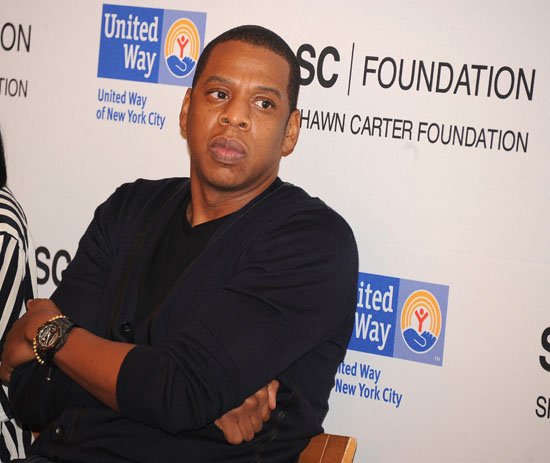
(Photocredit: Gossiponthis.com)

It’s been a busy year for Jay-Z: He released a joint album with Kanye West, Watch The Throne, that became the first post-Napster highly anticipated album to resist a leak(it was released digitally before physical copies). He released the very same album(complete with Ricardo Tisci cover art and $300 Givenchy T- shirts) in the midst of a worldwide recession, managing to make even the 1% feel poor. He sold(and pulled) ill conceived 99% solidarity attempts in the form of ‘Occupy All Streets’ t shirts. He announced he and wife Beyonce are expecting a child. He had classes taught about him at Georgetown.  He re-released his book ‘Decoded’, which even won him praises from notoriously icy NYT book critic Michiko Kakutani and once earned him a sit-down with Cornel West and others at the NYPL. He was likened, by Mr. West(Cornel, that is), to Aristotle and Shakespeare.


Yet when asked at a press conference just days ago at about his feelings on becoming the first solo hip-hop act to play Carnegie Hall(his two performances scheduled for February 2012), Jay-Z, normally confident cool and collected, demurred: “I feel like they bent the rules so it could make sense for me right now, but I’ll take it!”

Proceeds from the concert will go toward the Shawn Carter Foundation and United Way of New York City. These proceeds are expected to benefit low-income students throughout New York City’s public school system. Private sale tickets for the concert will range from $500 to $2500 before going on sale on January 30th to the public for, as of now, undetermined amounts. The goal, according to the foundation, is to raise as much money as possible.

The benefits for the concert go beyond charitable ones. The meeting of two world famous New York institutions arrives on a moment of intense transition for both. Jay-Z is not the first hip hop artist period to perform at Carnegie Hall, but he is the most visible and challenging to Carnegie Hall’s classically leaned status . Although hip hop has been accepted into Carnegie Hall before, the artists appealed to the classic tenants of hip hop: Soul loops, Boom Bap, and ‘conscious’ rhymes.


 Previous artists to perform at the space include MC Lyte, The Roots, Mos Def, and Lauryn Hill. MC Lyte is a product of Hip Hop’s Golden Age, while The Roots, Mos Def, and Lauryn Hill are artists from the same SoulQuarians collective. The rules have indeed, as Jay-Z remarked, been bent: Jay-Z will be the first hip hop artist in Carnegie Hall who is not an openly considered ‘Conscious Lyricist’ nor an openly considered devotee of jazz and soul inspired production. 


For Jay-Z, it is a chance to legitimize hip-hop on a scale previously unknown: Speaking at the press conference, Jay-Z said "Any time that I get a chance to expand and broaden the reach of hip-hop is a great thing for me on a personal level. But music is music. I believe all sort of music plays in all sort of venues, I’ve always believed that — from Yankee Stadium to Royal Albert Hall to Carnegie Hall.  I think if music is great, it works in great venues.”  He added: “And I have great music!”

Recent records of Jay-Z have shown him a more personally insular lyricist, and a more sonically adventuorous rapper. His last two releases, 2009’s Blueprint 3 and 2011’s Watch The Throne, are littered with samples rarely seen in a hip hop release: Dubstep, Oboe interludes, samples from Germn synthpop groups, prog rock peppered throughout, James Brown behind Eastern Flutes,  and auto-tuning, of all voices, Nina Simone. As for lyrics, after 2006’s coolly received record Kingdom Come, Jay-Z has subscribed to the ‘write what you know’ adage, writing verses celebrating his exceptional wealth, alternatively lamenting and attacking lost friendships, and extending his brand partnernships.

It is unknown how Jay-Z’s lyrical and sonic progression will play in the seats of Carnegir Hall, but Carnegie representatives are hoping splendidly. In 2007-2008,Carnegie Hall had an operating shortfall of $40.2 million. A 2009 breakdown reveals
$48, 483, 776 in Revenue, and & $73, 241, 325 in Total Functional Expenses. It is hoped that the star power of Jay-Z will attract new visitors, and that news of his appearance will encourage listeners to check out Carnegie’s storied programs. Classical music, the form of music most associated with Carnegie Hall, has seen a severe dip in record sales. In 2010, classical music record sales dropped 25%. The only genre that did not experience any drop-off was the genre that Jay-Z calls home-Hip Hop.

In February, two New York institutions will collide, hoping, in their own way, for a little help from an unexpected friend.


Wednesday, November 16

Smooth Is The Water Where The Brook Runs Deep.


(A worker in a New York Water Plant. Photo credit: Randolph Mase)
                   The New York City Water Board is rarely spoken of, but perhaps that is because the nature of its service: To remain as seemingly smooth and natural as spring water rounding a river rock; a set of only six board members (appointed to two-year terms by the mayor) working behind the scenes of something so omnipresent.
An afterthought for many New Yorkers, the water infrastructure brings in an estimated one billion gallons of water to New York City each day. It is the responsibility of the New York City Water Board to determine the rates and regulations that fund this flow of water throughout NYC. The Water and Sewer System is simply referred to as ‘The System”, but the Board is invested in considerable transparency, offering regularly updated, accessible reports on meeting minutes, rate regulations, public notices, and more, including a little Blue Book with very large plans.
In addition to determining rates, the New York City Water Board (working with the Department of Environmental Protection) is involved in initiatives to fund large projects. The largest and most expansive are the plans for the Croton Water Filtration Plant.
Plans for the Croton Water Filtration Plant. Photo Credit: NYC Gov Parks)

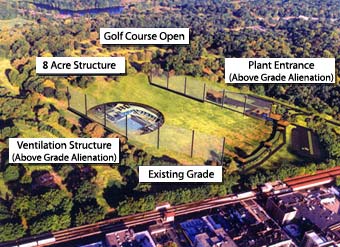
The Croton Water Filtration Plant, which will start in 2012 and is planned to be operational in 2013, will be the first WTP to be located in the boroughs of New York.  It will have the capacity to handle 30% of New York’s water supply, and will be located underneath the Bronx’s Van Cortlandt Park. All told, it will be the single largest construction contract in New York history.
At an estimated cost of 3 billion dollars and 12 acre construction (including an estimated 73,000m of rock and soil to be excavated), the DEP has worked to ensure good will with the Bronx community. The DEP has agreed, in partnership with the New York City Department of Parks and Recreation, to offer $200 million toward developing parks throughout the Bronx. Space has been an issue, including the Plant’s temporary takeover of the Mosholu Golf Course in Van Cortlandt Park. Ten acres of land will be turned back into a gold course upon completion of the Plant.
While issues of space in the Plant have arisen, funding has proven an occasionally even choppier obstacle.  Funding for the Croton Water Filtration Plant (and other projects) has been costly. According to a 2012 Blue Book report, DEP’s ‘current daily expenditure rate is nearly $9 million per day on construction, design, and construction management’. One way of closing the current $26.6 Billion debt is a proposal by the board to increase water and sewer rates by 7.5%. The estimated annual household cost to fund the Croton Water Filtration Plant mandate would be $44, nearly double the cost of the Ultraviolet Disinfection Facility ($23), but only slightly more than the Newton Creek Treatment Plant ($42).
If New Yorkers feel the rates are too high, too low, or, even, just right, the New York City Water Board will be meeting this Friday (November 18th) at 8:30 A.M at 22 Reade Street (Spector Hall). 

Wednesday, November 2

The Evolution of The Prospect Park Zoo

The Prospect Park Zoo, Brooklyn's only zoo, began as a small menagerie in the late 1800's.  It officially became a zoo in 1935 under the direction of Robert Moses, and the design of Aymar Embury II.  At it's very center was this statue of a lioness and her cub. Despite the many drastic changes to the Prospect Park Zoo, this statue has remained to this day, a remnant of past, present, and future. The statue has moved only slightly, shifting position due to Robert Moses' concern that children would use the statue as a slide.

The Center of Prospect Park Zoo

The Zoo in its original 1935 design.
The zoo today.
Stairs have been added on both sides of the preserved center walkway. A restroom is on the left, a refreshment center to the right.


Seals, and Security
The original zoo design consisted of elevated cement platforms and large, intimidating fences to protect visitors. Here, visitors interact with a polar bear. In 1987, an 11 year old boy, Juan Perez,  would sneak into the zoo at night, scale the fence to the Polar Bear pit, and be mauled to death( furthering sentiment that the facilities were weakened and larger animals would have to be moved from the zoo).


The current seal display offers an intricate, wide bar separating seal and visitor. Seals are known to come to the very edge  to greet visitors.
The original seal pool, offering elevated platforms, and closer visitor/seal interaction.


A seal rising up to greet a visitor.


Bricks, (Jungle) Books, and Conservation


The zoo was once home to many large animals, including Asiatic bears and lions.  These large animals were transferred to other zoos when the park closed in 1988. The renovated park re-opened in 1993, housing much smaller animals but still retaining trademark qualities, like the brick and Jungle Book inspired drawings.


One of three buildings today surrounding the main area: 'Animal Lifestyles'(formerly the Elephant House), Animals in our Lives(formerly the Lion House), and the World of Animals building. For each building, the red brick with limestone trim and a scene from The Jungle Book remain.


Writer Erik-Sanberg Diment once deemed the Prospect Park Zoo the 'rattiest in New York---in a literal sense of the word'. Large animals like elephants and bears often had little to live with, and had major issues with public interaction and sanitation. In 1980, a fifty year agreement was reached with the Wildlife Conservation Society to revitalize the Prospect Park Zoo, and transform it into the zoo for smaller, unaggressive species.


Tribute is still paid to the former residents of the Prospect Park Zoo. Above the restrooms and the refreshment centers  hang multiple Elephant head statues. The lioness and elephants of old remain a vital spirit of the current Prospect Park Zoo.

Sunday, October 30

Dinner & Discussion

 Good discussion and good food are rarely adjoined in the life of a busy college student. A new program at The New School aims to change that: In a new initiative known as 'Dinner and Discussion' , launched by the University Student Senate, students are encouraged to feast, and chew the fat while they're at it.
At the October 24th New School 'Town Hall' meeting, a (USS) representative emphasized that Dinner and Discussion "offers students a good meal, and just a forum to talk about topics in a really informal manner", she said.  D&D is an attempt to provide a warmer, less rigid symposium for students to engage in vital issues."A lot of times you have panel discussions and all these things going on, so this is more of a brown bag where students can just kind of swap ideas".  Pizza(the dietary staple of many college students) has become the go to food choice so far, but USS leaders are open to suggestions.
As for topics of discussions, it is clear that one issue has emerged as the focus for students: Finance. The first discussion was about OWS, and the October 24th meeting began an extended discussion of financial opportunities for students(The title: Dinner and a Discussion: Is Your Money Funny?). Students are also encouraged to present any issues or programs that would benefit the university(Last year for the first time, at least one student in every division of the New School received funding from an event.) 
The next Dinner & Discussion will be held on Friday, November 4th 6-8 P.M. The discussion is titled: Occupy the Financial System: Your Banking Choices.

Sunday, October 23

STORY EDIT: New York City Council Member Margaret Chin

Margaret Chin has been the District 1 council member since January 2010. Chin, a Democrat, was the first Asian American woman elected to city council(CONSIDER MAKING THIS YOUR FIRST SENTENCE? IT IS MORE COMPELLING) She has been actively participating in the fight to protect schools, senior citizens, and community organizations from budget cuts, having “called on Albany to support an additional surcharge on the top 2% of New York households,” according to her city council website.

Chin moved to the United States with her family from Hong Kong, China, when she was nine years old. Chin grew up in Chinatown, attending P.S. 130 and JHS 65 for school. After attending the Bronx High School of Science, she attended the City College of New York, receiving a degree in education(CAPITALIZE EDUCATION?).
Photo courtesy of council.nyc.gov
Following college, Chin became very active in enriching the rights of Asian immigrants. She helped found Asian Americans for Equality, a group that was designed to help Asian Americans and other immigrants who were in need. Chin served as the president of the group from 1982 until 1986. Chin also worked at a continuing education community college, helping immigrants get a college education. Chin’s(BE WARY OF REPETITION IN SENTENCES. THIS IS THE THIRD SENTENCE IN A ROW THAT BEGINS WITH 'CHIN') father came to America before the rest of his family did, and his struggles during that time period have always motivated Chin to helping improve the quality of life for immigrants(HOW DO WE KNOW IT HAS ALWAYS MOTIVATED HER? DO YOU HAVE A SOURCE?).

District 1 in Manhattan in made up of the lowest parts of Manhattan. Canal Street serves as its northern border, going all the way down to the bottom of Manhattan. District 1 includes the Financial District, Battery Park City, Tribeca, Ellis Island, and Governor’s Island(I QUESTION THE PLACEMENT OF THIS PARAGRAPH. IT IS A ROUGH TRANSITION RIGHT NOW. IS THERE A WAY TO WEAVE THIS INFO INTO ANOTHER PARAGRAPH, IN A WAY THAT CONTINUES THE NARRATIVE AND DOES NOT MOMENTARILY INTERRUPT IT?).

Chin has been dealing, as has everybody in the area, with Occupy Wall Street('DEALING' CAN HAVE A NEGATIVE CONNOTATION. FURTHERMORE, I THINK THE 'AS HAS  EVERYBODY IN THE AREA' NEGATES THE PARTICULAR SITUATION SHE IS IN THAT YOU DESCRIBE IN THE NEXT SENTENCE).. She has come under fire recently for not marching with on Zuccotti Park with other members of the City Council, despite being one of the most liberal members of the Council. Multiple articles have sighted that while in college, Chin was a member of the Communist Workers Party(CAN THIS BE EXTENDED? IT IS A RATHER BIG PIECE OF INFO THAT WILL DISTRACT THE READER IF IT IS CASUALLY MENTIONED IN A LONG PARAGRAPH). Her response for why she was not at the march was due to a “scheduling conflict”, adding, “I have been to so many marches.”(NICE QUOTE. AND GREAT LAYOUT, BY THE WAY).

Chin also serves as the Lower Manhattan Redevelopment Committee Chair, having recently conducted a research project about furthering preliminary cancer research. Chin is married to Alan Tung, a public school teacher, and has a son, Kevin, who graduated from Syracuse University(THIS PIECE HAS A RATHER ABRUPT ENDING. I THINK INFORMATION ABOUT HER FAMILY SHOULD BE PLACED MUCH EARLIER, AND HER OTHER WORK DOES NOT SEEM TO BE THE FOCUS OF THE PIECE. WHAT WOULD YOU CONSIDER THE FOCUS? WHAT ISSUE IS SHE MOST PASSIONATE ABOUT? I WAS NOT SURE. YOU PROVIDE GREAT INFO ON HER FIGHT FOR PROTECTION AGAINST BUDGET CUTS, ENHANCING RIGHTS FOR ASIAN IMMIGRANTS, AND FURTHERING PRELIMINARY CANCER RESEARCH. HOWEVER, I COULD NOT DISCERN WHICH PARTICULAR ISSUE WAS THE FOCAL POINT. YOU SAY SHE IS ONE OF THE MOST LIBERAL MEMBERS OF THE COUNCIL. DO YOU THINK A POSSIBLE FOCUS COULD BE A CONTRAST BETWEEN HER LIBERAL REPUTATION AND HER RELUCTANCE TO EMBRACE THE OWS MOVEMENT? I FOUND THAT TO BE THE MOST COMPELLING ANGLE.)

Wednesday, October 19

City Councilman James Gennaro


                                              (Photo Credit: Weissman for NY Daily News)


A famous, Hollywood-embraced environmental politician with an endorsement from Senator Hilary Clinton. It is not Al Gore, but rather, 24th Council District representative James Gennaro(D). Gennaro holds the distinction of being perhaps one of the most environmentally progressive politicians in the history of New York state: Currently the Chairman of the Council’s Committee on Environmental Protection, Gennaro has attained a stature as that extends beyond the borders of New York, appearing at the Sundance Film Festival twice (he was involved in the documentary 'FUEL', a winner of the Best Documentary Audience Award). Like the most famous environmentally friendly politician, Gennaro is undeniably earnest: He speaks in a energetic, sometimes rambling voice, a voice known to be amusing even in disagreement (In a YouTube video, he calls the Environmental Control Board a ‘real kangaroo court’.) Capital New York writes: “He also gives the impression of being genuinely enthusiastic about rock formations.”


James Gennaro (preferring to go by ‘Jim’) took office in 2002 as a geologist turned politician. Gennaro has used his extensive background to promote ‘green’ buildings, protect and restore Jamaica Bay, regulate water and sewer rates, and reduce pesticides, to offer a few. Gennaro has also been apart of numerous other initiatives, including delivering (in 2006) one million dollars in technology for children, and funding over 100 senior and youth based initiatives. The New York City Council website emphasizes Genarro’s broad work, calling him a “one-stop shop” for thousand of constituents. 


While some have praised Gennaro’s wide-ranging activity, others have questioned his means of gaining public support, sometimes at the detriment of other city projects. In 2007, it was revealed that James Genarro accepted donations from the Kamali Developers, an organization that sought to build St. Johns dorms Genaaro was openly opposed to (Gennaro identified himself as a “ardent opponent to the dorm project and advocate for what is best in the community”). In a September 2007 article, The Queens Courier reported that, when asked about the donations from the Kamali Campaign, Gennaro replied: “We all have to raise campaign funds”.

In 2008, Gennaro ran for senate against republican senator Frank Padavan, a District 11 representative. A longtime member of the Queens community, Padavan was a long time fix in the community, generating goodwill despite a favored Democrat community make-up. After 3 months of recounted ballots (at one point Padavan challenged the legitimacy of some St. Johns students who had voted), Padavan was announced the winner. Gennaro’s YouTube page contains numerous campaign videos, and the account was last updated in 2009. A visit to jamesgennaro.com is met with a white screen and small text reading “Coming soon........Under construction”.


In 2009, Gennaro was re-elected for a third term as 24th Council District representative (a term that will last until December 31st, 2013).  For the last three and a half years, Gennaro has focused on generating opposition to the draft guidelines for “fracking”: The extracting of gas from untapped natural gas reserves (also known as the “Haliburton Loophole”, because Halliburton is a main player in fracking and exempt from the Clean Water Act). Gennaro is considered a leader in the “the biggest environmental issue almost no one in New York City is paying attention to.” Gennaro concedes, ”I’m a local legislator. I don’t control what the state does. But I’m trying to do the best I can trying to get people to understand what’s at stake”. “

Gennaro has called for a moratorium on all activity until the science is done, but the goal remains distant. Gennaro seems an ideal candidate for an environmental issue still barely pulsating in the hearts of New Yorkers: An unassuming, dedicated-almost-to-a-fault environmentalist, James Gennaro continues to believe that the spring will not be silenced.


                                                (A breakdown of the 24th District)